
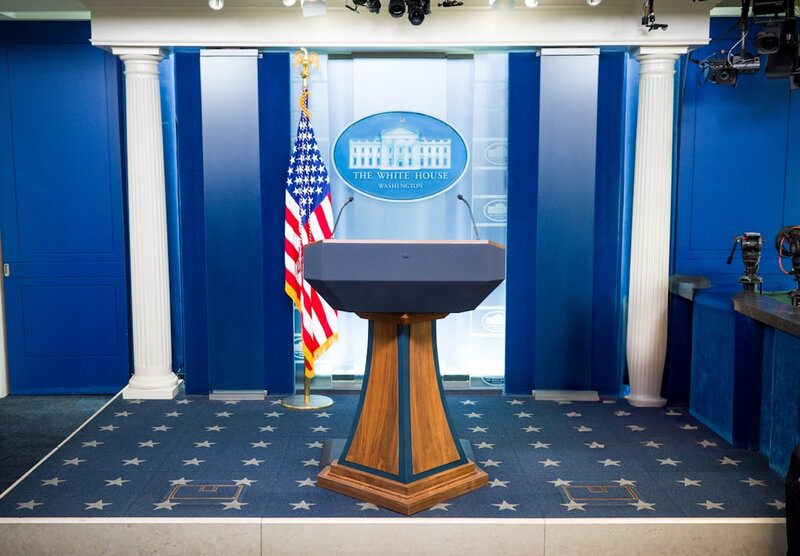

A man who operated the teleprompter at the White House has been fined for insider trading on prediction markets. Gabriel Perez read the speeches before they were delivered, then bought contracts in “presidential mention” markets on whether particular words and names would come up, and cleared six figures doing it. The mechanism was not exotic. He knew the answer, and then he went and bought the answer.
TL;DR
- An ex-White House teleprompter operator was fined for trading prediction markets on speeches he had read in advance, profiting more than $100,000 on “presidential mention” contracts.
- Nothing broke. The markets settled correctly, the resolution source was accurate, and the game was still rigged, because the outcome existed before anyone bet on it.
- Fairness has two independent halves: was the outcome unsteerable, and was it unknowable to everyone who committed funds. Verifiable randomness answers only the first.
- An outcome that is generated at resolution cannot be known in advance, because there is nothing there to know. An outcome that is observed pre-exists its own settlement, and anything that pre-exists can be held by somebody.
- That is scope, not virtue, and the honest version comes with limits. This is the forty-first unasked half of fairness.
The part where nothing went wrong
Start with what did not fail, because the list is long and it is the whole point.
The market resolved correctly. The contracts paid out exactly as written. Whoever or whatever reported the speech contents got them right. No oracle was compromised, no settlement rule was abused, no counterparty vanished, no smart contract misbehaved. If you audited the resolution end to end you would find a clean, accurate, defensible record of a market doing precisely what it said it would do.
And the people on the other side of those trades never had a chance. Not a small chance. Not bad odds. No chance, on the specific contracts he chose, at the moment he chose them.
The entire vocabulary this industry has built for fairness is designed to detect the failures that did not happen here, and has almost nothing to say about the one that did.
Generated versus observed
Here is the distinction that carries this post. Outcomes come in two kinds, and they are not close relatives.
A generated outcome does not exist until the moment of resolution. A verifiable random function produces a number that was nowhere in the universe beforehand. There is no earlier copy, no draft, no rehearsal. It is not retrieved, it is made.
An observed outcome exists before it is settled. The speech was written on Tuesday and delivered on Wednesday. The match was played. The closing price was reached. Settlement is a report about a thing that already happened, or that was already determined by processes running in the world well before the market closed.
Insider trading is only possible against the second kind. Not “harder to prevent”. Not possible at all against the first. You cannot obtain advance knowledge of a number that has not been generated, no matter who you are, who you know, or what building you work in. The advantage is not prohibited, it is uninstantiable.
This is why every observed-outcome market in the world, from equities to prediction markets, reaches for the same tool: a rule against knowing, plus enforcement, plus a fine afterwards. That is not a mechanism, it is a deterrent, and it runs on somebody noticing and somebody deciding to act. Which is the fifth instalment of this series again: discretion has no direction. The apparatus that fined a teleprompter operator is the same apparatus that decides, on some other day, that a case is not worth pursuing.
Two halves, and the industry only sells one
Break “was that fair” into its parts and you get two questions that do not imply each other.
Integrity: could the outcome be steered by anyone after money was committed? This is what provable fairness answers. The Chainlink VRF proof is verified on-chain before the number is usable, and the arithmetic that turns it into a winner is public and rerunnable.
Symmetry: at the moment each participant committed, did any of them already know the answer? Provable fairness says nothing about this whatsoever. A perfectly honest, fully verified, cryptographically flawless settlement of an outcome that one participant read off a teleprompter the day before is a proof that the arithmetic was correct and a total silence on whether the game was worth entering.
Almost every “provably fair” badge in crypto gaming is a claim about the first half only. It is a real claim and I would rather have it than not. It is also, on its own, a claim about half the question.
Where a Satoshie draw actually sits, including the awkward part
A coinflip and a raffle are generated outcomes. There is no referent, no outside fact, no earlier copy. Nobody at Satoshie knows the winning ticket before the callback executes, and that is not a promise about our conduct, it is a statement that the number does not exist yet. That is the strongest form of this argument, and I want to be careful not to inflate it, because it comes with three real limits.
One: the oracle sees it first. A VRF output is deterministic given the seed and the node’s committed key, which means the node computes the value before it lands on-chain. It cannot grind it, change it or pick a better one, since the key was committed in advance and the proof would not verify. But there is a window, measured in blocks, where an honest number exists in a place that is not yet public. The exploitable version of that is not manipulation, it is withholding, which is the liveness problem from the third instalment wearing different clothes, and the answer is the same one: a permissionless, time-bounded recovery path that anyone can trigger, not an onlyOwner button.
Two: public is not the same as read. ticketsMinted sits on-chain and moves as people buy. A late entrant who checks it knows the odds better than an early one who did not. That is a real asymmetry and I am not going to pretend it away, but it is a different species: it can be closed by any member of the public deciding to look. That is the test worth carrying around. Could a stranger close this gap by working harder? If yes, it is effort asymmetry, and the fix is design. If no, it is privileged information, and no amount of transparency touches it. Nobody could have closed the teleprompter gap by reading harder.
Three, and this is the one that actually constrains us: the moment anybody in on-chain gaming ships a product whose outcome is observed rather than generated, insider knowledge becomes instantiable again, immediately and permanently. Sports books. Will-BTC-close-above-X. Anything settled off a price feed, which the thirty-fourth instalment covered from the verification side. The branding does not change. The VRF integration may still be there, still real, still verified. And the category has changed underneath it.
So the commitment is narrow and checkable: nothing gets called provably fair here if the result could have been known in advance by anyone, and any future game settled on an outside fact gets labelled as such before you can bet on it, with the proven half and the trusted half stated separately.
Three questions
Did this outcome exist before I committed? If it did, someone could have held it, and the only thing standing between you and that person is a rule and an enforcer.
Who would have known first, and what would it have cost me to find out? If the answer is “nothing, I could have checked the chain”, that is effort. If the answer involves a building I cannot enter, that is an edge.
Does the proof I was shown cover knowing, or only steering? Because almost all of them cover steering, and steering was never the half that got the teleprompter operator paid.
The uncomfortable version of this week’s story is that the market worked. The record is clean. Every check an auditor would run comes back green, and a fine still had to be issued by humans after the fact, because the failure was never in the mechanism. Games where the answer is made at the moment of asking do not need that apparatus. That is a narrow property, it is not a moat, and it stops being true the second the outcome starts coming from somewhere else.
📷 Photo by Nils Huenerfuerst on Unsplash