
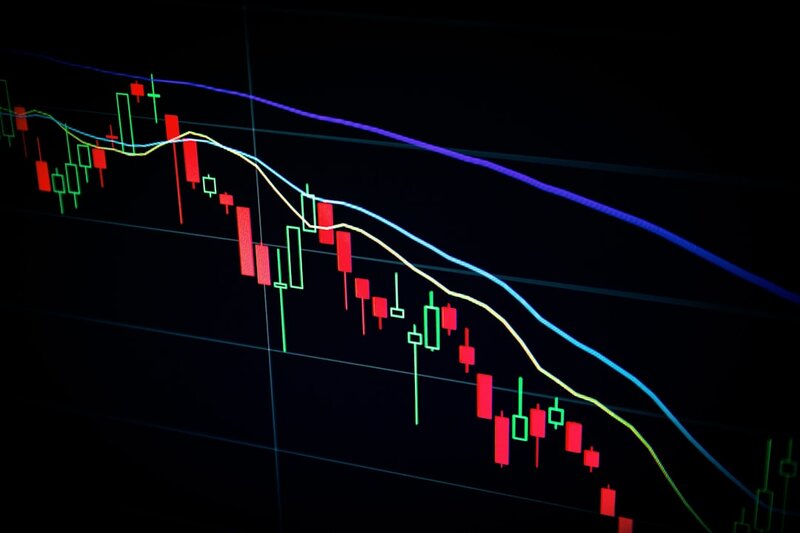

Two CoinDesk headlines this morning, seventy-five minutes apart. At 04:40 UTC: bitcoin slips under $79,000, every major token down on the day, traders pricing roughly a 60% chance of a Fed hike next week. At 05:56 UTC: bitcoin’s golden cross is here, indicating a potential long-term bullish trend ahead.
Neither headline is wrong. Neither is a correction of the other. They are statements about two different things, and the fact that this needs spelling out is the entire subject of this post.
TL;DR
- A golden cross is the 50-day moving average crossing above the 200-day. Both average prices that already happened, so the signal lags by construction.
- It is also one of the most verifiable objects in finance: public inputs, reproducible arithmetic, same answer for everyone. And it fired on a day bitcoin fell.
- Verifiability is a property of a computation. Checkability is a property of a claim. A golden cross has the first and none of the second, because it states no probability, no magnitude and no horizon.
- A statement that survives every outcome is not a forecast. It is a description of the past with a mood attached.
- The rarest species of claim is a distribution fixed in code before you commit money. That is what provably fair on-chain gaming sells, and it is not a price prediction.
What actually happened this morning
A golden cross triggers when the 50-day simple moving average rises through the 200-day. Both lines average closing prices that have already printed, so the cross cannot fire until enough of a move is in the books to drag one average through the other. It lags not by poor design but definitionally. You are looking at a summary of the last two hundred days.
Here is the part worth sitting with: by the standard this blog spends most of its time defending, a golden cross is exemplary. Every input is public, every step reproducible, and anybody with a spreadsheet and a price history gets the identical answer without cooperation from CoinDesk, an exchange, or whoever posted the chart. No black box, no proprietary model, no “our analysts believe”. If verifiability were the whole of the virtue, technical analysis would be the most honest thing in crypto.
And it fired on a morning the price was falling.
Give the chart its due
This is not the paragraph where technical analysis gets called astrology. Enough capital watches the same lines that they acquire real reflexive weight, which makes them partly self-fulfilling and therefore partly real. A mechanical rule telling you when to reduce is worth more to most people than an accurate forecast they will not act on. And it is open: a rule anyone can recompute beats a conviction nobody can inspect. So the objection here is narrow, and it is not about the maths.
A computation you can recompute is not a claim you can check
These are two different properties and the industry treats them as one. Verifiability attaches to a computation. Did the arithmetic get done correctly over the stated inputs? For a moving average cross, trivially yes, and anybody can confirm it. Checkability attaches to a claim about the world. Could this statement turn out to be false, and would we be able to tell?
A claim about the future is only checkable if it states a probability, a magnitude and a horizon. How likely, how far, by when. “Indicating a potential long-term bullish trend ahead” states none of them, and so it cannot lose. Price goes up: the signal worked. Price falls first and recovers: a shakeout, the signal worked, note the words “long-term”. Price falls and stays down: macro overrode the technicals. Every branch is consistent with the original statement, which means the original statement was never carrying information about the branches.
That is not a forecast. It is a verifiable description of the past with a mood attached, and the mood does all the work in how it gets read.
The better-shaped claim in the same news bundle
Look at the other headline again: traders pricing roughly a 60% chance of a Fed hike next week. That is a different species. It names an event, a resolution date and a number, and its source is a market rather than a chart pattern. It is imperfect too, since a 60% probability on a one-shot event never verifies on a single observation. But the claim has a shape, it can be disagreed with in a way that means something, and that already puts it in a different category from the cross.
The third species, and why we build one
There is a rarer thing than either: a distribution over an event that has not happened yet, fixed in code before anybody commits money and readable by a stranger. That is what a provably fair game is, and it is why the phrase deserves defending against the marketing departments currently wearing it.
When you buy a Satoshie raffle ticket, ticketsMinted is contract state on Base. Read it, divide, and that is your probability. Not our estimate of it, not a figure from a support desk, not an RTP self-reported over a window we chose, but arithmetic over a public number, computable before you enter by someone who does not work here. A coinflip resolves as randomWords[0] % 2 on a Chainlink VRF word, with the coordinator verifying the proof on-chain before the callback fires and the payout landing in the same transaction.
Fifty-fifty is not a prediction about the coin. It is a property of the machine, and the machine is deployed, immutable and public. The difference from a chart signal is not that we are more accurate about the future, but that the statement was made in advance in a form where being wrong is possible and demonstrable without our cooperation.
Honest limits, because the same argument points inward
A 50/50 tells you precisely nothing about whether you win. Provable fairness gives you the distribution and never the draw, and anyone selling verification as an edge is selling the wrong product. The distribution also includes the house’s cut, which means fair and profitable-for-you are unrelated properties: the games here are honest and, played long enough, negative expected value for the player.
And none of this is a view on bitcoin. A VRF proof has never had anything to say about a price, and any platform implying otherwise has confused two businesses.
The question worth carrying
“Can I verify this?” is becoming a weak question. You can recompute a moving average, a proof-of-reserves snapshot, a burn condition, a treasury balance; the industry has got very good at handing you things to check. The better question is: verify what, exactly. Verification runs backwards. It takes an event that has already occurred and returns true or false. Point it at the future and there is nothing for it to grip, which is why a perfectly reproducible calculation over two hundred days of history can be dressed as a statement about the next two hundred and never once be caught out.
A published probability, fixed in a contract before you enter, is the other thing: a statement about the future that is a term of the deal rather than a feeling about it. Small distinction, not exciting, and the whole of what separates a game from a chart.
Read your odds off the contract before you enter, not off a headline. That is the whole of Satoshie.
📷 Photo by Maxim Hopman on Unsplash