

Eighteen attorneys general signed a letter to the Senate Banking Committee asking senators to vote no on the CLARITY Act. The signature page is the interesting part. Letitia James of New York at the top, Kris Kobach of Kansas a few names down, Rob Bonta of California and Andy Wilson of Ohio sharing a sheet of paper. Seventeen states plus the District of Columbia, which is why you will see the coalition reported as seventeen in one outlet and eighteen in another.
They are not arguing about whether a token is a security. That fight has run for years. They are arguing about something further down the stack, and quieter: who is allowed to bring the case when somebody takes your money.
TL;DR
- A bipartisan coalition of 18 attorneys general, led by Letitia James, wrote to Senate Banking chairman Tim Scott and ranking member Elizabeth Warren on 14 September 2026 urging a no vote on the CLARITY Act (H.R. 3633 R.S.) ahead of Tuesday’s procedural vote.
- Their objection is not classification. It is preemption: the bill’s language, they say, is “ambiguous, unclear, or confined” in ways that could strip states of the power to prosecute crypto fraud.
- The states report 330-plus anti-fraud enforcement actions since 2017, prioritising cases “where the victims had no federal, private, or other recourse”.
- The unasked half: a right is enforced by somebody else on your behalf, and that somebody is granted by statute and can be removed by statute. A proof is checked by you, and nobody has to grant you permission to check it.
- Satoshie’s coinflip and raffle outcomes come from Chainlink VRF and settle in the contract. That does not give you an attorney general. It gives you the one thing an attorney general cannot: an answer about last night’s draw that does not depend on anyone agreeing to act.
What the letter actually says
Read it rather than the headlines. The coalition is not making a vibes argument about federalism, it is making a resourcing argument with numbers attached. The FBI’s 2025 Internet Crime Report logged $11.4 billion in losses from crypto-related complaints, up 22% year on year, average reported loss $62,604. TRM Labs put illicit crypto volume at roughly $158 billion for the year, up nearly 145%.
Against that, the states offer their own record: more than 330 anti-fraud enforcement actions since 2017, and, in the letter’s phrasing, “prioritizing cases where the victims had no federal, private, or other recourse against the scammers”. State regulators, they write, “are often first responders to investment fraud and frequently are the only regulators positioned to deliver accountability and recovery for constituents”.
Then the line that does the most work:
“Even though states will prevail in enforcing laws that are not preempted, the benefit of litigation and delay caused by ambiguity accrues to bad actors.”
That is eighteen law enforcement offices stating, in writing, that winning is not the same as protecting anyone. They expect to win. They are telling the Senate that winning will arrive too late to matter.
The half nobody asks about
You have never once enforced your own fairness. Not in a casino, not on an exchange, not anywhere. Somebody else did it for you, or nobody did.
That is not a failure of the system, it is the design of it. Rights are adjudicated by an institution with standing, a budget, subpoena power and a mandate. You supply the complaint. If the institution does not act, the rule protecting you is still on the books, still correctly worded, still completely inert. A rule with no enforcer is a rule you can read.
Which means every fairness guarantee you have ever been offered by a gambling operator has a hidden dependency that is never printed next to it. Not the rule. The enforcer. And the enforcer is granted by statute, funded by appropriation, staffed by people who choose which cases to open, and, this week, is a bargaining chip in a cloture negotiation seven weeks before a midterm.
Enforcement has a minimum size. Verification has none.
The second problem is arithmetic. Enforcement has a floor. Nobody litigates a €200 loss, because the cost of enforcement exceeds the harm in every case that matters to an individual player. That is why the attorneys general exist in this letter at all: they aggregate. They take the cases where the victim has no realistic path of their own, bundle the harm until it is large enough to be worth a courtroom, and act on behalf of people who were never going to sue.
Notice what that implies about the shape of an ideal fraud. Not the spectacular one. The one calibrated to sit permanently below the aggregation threshold: a small, quiet skim across a very large number of people, each losing an amount not worth anybody’s attention, none of them able to see the pattern because none of them holds the population. Every player sees their own losing streak. Only the operator sees the distribution.
Verification has no floor. Checking a VRF proof for a single flip costs the same whether the stake was €2 or €2,000, and it costs the same whether you are the person who lost or a stranger in another country who never played. There is no threshold of damages, no residency requirement, no question of whether it is worth opening a file. The proof either verifies against the published key or it does not, and the answer arrives in a block rather than a docket.
What the trade tells you
The timing is almost too neat. The same weekend the AGs sent their letter, the Associated Press reported that Trump had agreed to roughly 80% of a bipartisan ethics proposal from senators Thom Tillis and Ruben Gallego, turning the existing ban on federally elected officials issuing digital assets into a requirement to divest or use a blind trust. Part of that deal: state attorneys general get a role enforcing the new ethics restrictions.
So enforcement authority was handed to the states in the section that needed Democratic votes and clouded in the section that governs the market. Whatever you think of either provision, that is enforcement capacity behaving like a currency, spent where it buys something and withheld where it costs something. The thing standing between a player and a scammer is not a moral constant. It is a line item, and it moves.
What a proof does not need
Nothing on our platform gives you an attorney general. What it gives you is an outcome whose correctness does not route through anybody’s willingness to act. A coinflip stake is escrowed by the contract. Randomness is requested from Chainlink VRF, named in deployed code before you stake. The coordinator verifies the proof before the callback may deliver the word. The outcome is computed in that callback and the payout happens in the same transaction. There is no admin key and no window in which a human decides differently.
The consequence is narrow and worth stating narrowly: last night’s draw was either correct or it was not, that fact was fixed in its block, and establishing it requires no standing, no jurisdiction, no budget and no permission. It verified then, it verifies now and it will verify in 2030 whichever way Tuesday’s vote goes. The verifier does not need to be anyone in particular.
The honest limits
Three of them, and the first is the big one.
We do not have an attorney general either, and that cuts against us as hard as it cuts for us. If our front end lied about which contract it was calling, or a phishing clone took your funds, or the company simply stopped existing, there is no first responder for that. The states, by their own account, take exactly those cases, the ones where the victim has no other recourse. On-chain gaming’s answer to the preemption fight is not “we win”, it is “we are not in the room”, and that is an advantage in one direction and an abandonment in the other.
Second, a VRF proof settles randomness. It does not recover money, shut down a fraudulent operator, or deliver the accountability the letter is asking for. Proof and remedy are different products and only one of them is ours.
Third, the attorneys general are not wrong. A bipartisan coalition that includes both Letitia James and Kris Kobach is not manufacturing a grievance. Their objection is specific and technical, aimed at a “qualified transaction” loophole in the Securities Act of 1933 that would let the SEC exercise preemptive power indirectly, and at registration regimes that fund the fraud units doing the work. They deserve to win that argument on its merits.
Three questions worth asking your operator
- If I believe last night’s result was wrong, who exactly brings the case, and what is the smallest loss they would bother to bring it for?
- Does anything on your fairness page stop being true if a statute changes on Tuesday? If so, it was never a property of the mechanism.
- Can a stranger with no account, no loss and no authority check a specific result of mine, or does checking require somebody’s permission?
The states are asking the Senate not to take away the only champion most fraud victims will ever have. They are right to ask, and they may lose anyway, and even if they win the delay will have done its work. That is the machinery of rights, and it is the best machinery anyone has built for the class of problems it addresses.
It is also not the same thing as knowing. A statute can decide who is permitted to argue about your money. It cannot tell you whether the coin was honest. Only one of those answers survives Tuesday’s vote unchanged.
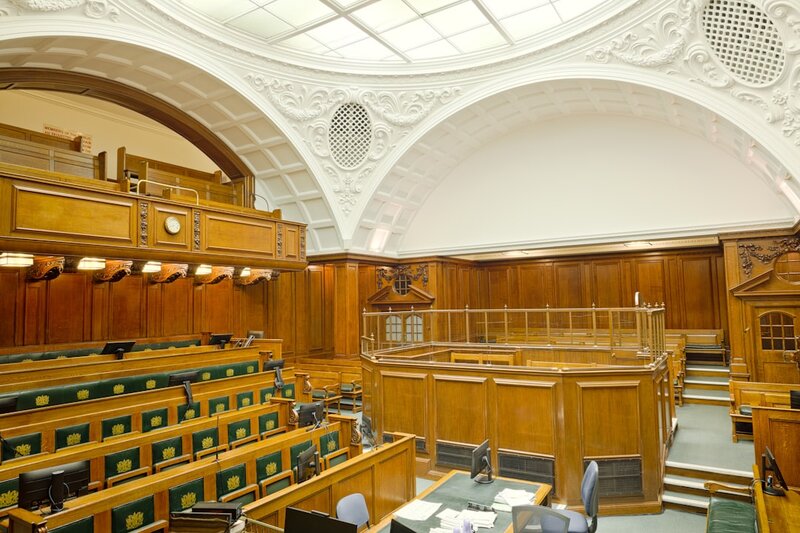
📷 Photo by Michael D Beckwith (@mdbeckwith) on Unsplash