

Circle opened the public mainnet of Arc on 16 September 2026, and the detail every headline led with was the one Circle wanted: USDC is the native gas token. Fees are denominated in dollars. No volatile asset to hold on the side, no treasury team explaining to an auditor why the company keeps a float of something that moved 9% overnight. Jeremy Allaire called it the single most significant launch in Circle’s history since USDC itself, and on the ergonomics he is not wrong. Blocks land roughly every half second with deterministic finality, twenty-plus fiat stablecoins are live, BlackRock’s BUIDL and Circle’s USYC settle natively, and the founding validator set reads like a clearing-house directory: BlackRock, DTCC, Galaxy, Global Payments, ICE, Mastercard, MoneyGram, SBI Group, Standard Chartered, Sumitomo and Visa, alongside Circle.
Everyone covered the fee asset as a pricing story. It is not a pricing story. When the asset you pay fees in is an asset somebody issues, the question stops being what a transaction costs and becomes whether you are allowed to buy one.
TL;DR
- Circle’s Arc L1 went live on 16 September 2026 with USDC as the native gas token, a permissioned proof-of-authority validator set of eleven institutions plus Circle, and sub-second deterministic finality.
- Arc’s own documentation states the USDC blocklist is enforced at runtime and that a value transfer to or from a blocklisted address reverts, independent of balance.
- On Ethereum a blocklist freezes one asset while you keep ETH and keep acting. On Arc the fee asset and the blocked asset are a single balance, so the same control reaches your ability to transact at all.
- Nobody has published the scope: whether a blocklisted account on Arc can still send transactions that do not touch USDC beyond paying for themselves. Arc also hides its mempool, so a refusal is not observable from outside.
- Provable fairness is a claim about how an outcome is computed. Collecting it is a state transition, a state transition costs a fee, and a permissioned fee asset makes settlement permissioned too. Satoshie runs on Base, where gas is ETH and nobody issues it.
One balance, two jobs
Start with what Arc actually shipped, because it is elegant and the elegance is the point. USDC on Arc has two interfaces over one balance: an 18-decimal native view used for gas, and the familiar 6-decimal ERC-20 view used by applications. Circle’s integration guidance for wallet developers puts it plainly: users “can hold USDC, send USDC, and pay network fees from the same underlying balance”, and wallets are told to render that as a single row rather than inventing a second token. No wrapping, no separate gas balance, no “you have funds but you cannot move them because you are out of ETH”. Anyone who has watched a new user bounce off that exact wall knows how much friction this removes.
Now read the compliance section of the same documentation. The blocklist, it says, is enforced at runtime, and a value transfer to or from a blocklisted address reverts. It reverts whatever your balance is, because balance was never the constraint. And an included transaction that fails a blocklist check still consumes gas. The wallet guidance goes further and tells integrators to surface the reason before mempool entry, with a suggested string for the user: “This transfer can’t complete because an address is restricted.”
Both of those paragraphs are reasonable in isolation. Read together they describe something the coverage skipped entirely. On every chain where USDC has lived until now, the fee asset and the issued asset were different things. Circle blocklists an Ethereum address and that address still holds ETH, still signs transactions, still moves its NFTs, still closes its lending positions, still pays a lawyer in a currency Circle does not mint. The frozen thing is a balance. The account survives. On Arc the fee asset is the issued asset, which means the control that freezes a balance and the control that funds a transaction are pointed at the same number.
The unasked half
Here is the question no article, no launch post and no documentation page I can find has answered: what is the scope of a blocklist on a chain where the blocked asset pays for everything?
Take an address holding BUIDL, cirBTC, a Morpho position and some USDC, and suppose Circle blocklists it tomorrow under a court order. The USDC is stuck, and that part is old news and largely uncontroversial. But every other asset in that account is reachable only through a transaction, and every transaction is paid for by moving USDC from that account to the network. Is that fee itself a value transfer from a blocklisted address? If it is, the account does not hold frozen USDC plus liquid everything-else. It holds nothing it can act on, including assets Circle neither issued nor has any claim over.
I am not asserting that this is how Arc behaves. I am pointing out that after a mainnet launch with eleven of the largest financial institutions on earth producing blocks, the answer is not written down anywhere a user can read it. The documentation tells you what happens to a transfer. It does not tell you what happens to an account.
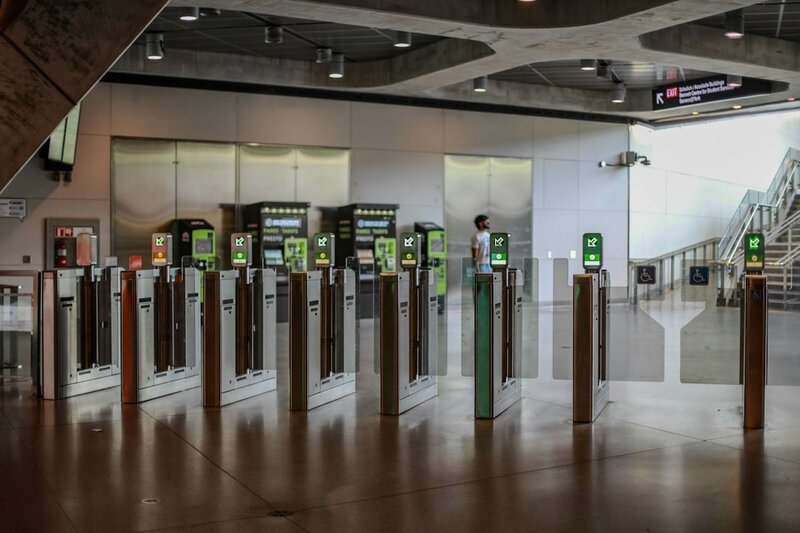
This blog has drawn a line before between whether a transaction is valid and whether anyone will carry it, when a consensus-legal Bitcoin spend turned out to need a commercial relationship with a miner to get relayed. The Arc question is a third thing, earlier in the sequence than both. Before validity and before carriage there is eligibility: can you pay the toll at all. A chain can be perfectly honest about ordering and perfectly deterministic about finality and still have a turnstile at the entrance that an issuer controls.
One more detail sharpens it. Arc does not expose its mempool over RPC; pending transaction filters return an error rather than a queue. There is nothing sinister in that on its own, and plenty of institutional reasons for it. But it means a refusal at the entrance is not visible to anybody except the person being refused, and the only artefact is a string in their wallet telling them an address is restricted.
Credit where it is owed
Circle is not doing anything underhanded here, and it is worth being specific about that. USDC is a regulated dollar liability with a real issuer, and the blocklist is not a hidden feature, it is disclosed in the developer documentation with the exact semantics spelled out. That is a great deal more than most of this industry offers. Circle has also floated reversible transfers and then said publicly that such a thing would sit as a layer above Arc rather than inside it, which is the right instinct and a different argument for a different day. Arc is built for institutions that want a vetted validator set and enforceable controls, and for that buyer the design is not a compromise, it is the product.
The objection is not that Circle will abuse this. It is that “provably fair” on a chain like Arc would describe the arithmetic of an outcome while leaving the door to the room owned by somebody else. Fairness arguments do not survive being scoped narrowly and then quoted broadly.
What this means for a game
A provably fair draw is a claim about how a result is produced. It says the number was not chosen by us, that it was generated verifiably, and that you can check it afterwards. It says nothing whatsoever about your ability to collect the thing the number won you.
Collecting is a state transition. A state transition costs a fee. If the fee asset is issued and blocklistable, then the final step of a provably fair game, the only step that actually pays you, runs on a permission you do not hold and cannot verify in advance. A crypto casino deployed on a stablecoin-gas chain could publish a flawless verification page, prove every outcome for ever, and still have a settlement path that depends on an issuer’s compliance queue. The proof would survive that. The promise would not.
Satoshie’s claim is narrow and mechanical. We run on Base. Gas is ETH, which no company issues, no company can blocklist, and which carries no relationship between you and an issuer to be revoked. Our raffles and coinflips draw randomness from the Chainlink VRF coordinator named in deployed code you can read before staking, the proof is verified on-chain before the callback can deliver, and the payout is escrowed in the same transaction that resolves the outcome. There is no fee-layer permission between winning and being paid, because there is nobody who can decline to sell you a fee.
Three honest limits
One: Base is not decentralised today. The sequencer is operated by Coinbase and it can reorder or delay. The backstop is L1 forced inclusion, and note that this backstop is only a backstop because the escape hatch is priced in ETH. An exit path denominated in an asset your adversary issues is not an exit path. That is the whole argument in this post, applied to us.
Two: prizes are a separate question from fees. If a prize is paid in a stablecoin, the issuer of that stablecoin can freeze it, and no contract we deploy fixes that. We inherit that risk rather than removing it. What we are claiming is narrower: the machinery that settles your game is not gated on anyone’s permission.
Three: Arc solves a real problem and we have not solved it. Dollar-denominated fees genuinely are better for accounting, budgeting and anyone who does not want a volatile asset on the balance sheet. ETH gas is a cost we pass to you in a currency that moves. Arc traded permissionlessness for predictability deliberately. The criticism is not of the trade, it is that the trade was reported as a fee story when it is a control story.
Three questions to ask any platform
- What asset pays the fee for the transaction that pays me, and who issues it?
- If that issuer restricted my address tomorrow, could I still move assets they have nothing to do with, or does the restriction reach my ability to transact at all?
- When a transaction of mine is refused at the entrance, is that refusal visible to anyone other than me?
Arc will probably work beautifully for the institutions it was built for, and its documentation is more candid about its controls than most of this industry manages. But a fee is not a price when somebody can decline to sell it to you. It is a permission with a number printed on it, and a proof of fairness that stops at the turnstile was never a proof about the thing you actually wanted, which was getting paid.
📷 Photo by Angelica Hasbon on Unsplash