
A solo Bitcoin miner found a block this week and walked away with roughly $200,000. CKPool’s developer put the winner’s hashrate at a “wildly variable” peak of around 100 PH, and noted it was probably rented. One person, some borrowed machines, and a payout that most crypto gaming platforms would call a jackpot.
Here is the part nobody in crypto gaming wants to sit with. That was a lottery, and it is very close to the only lottery in this industry where the winner could have calculated the odds before buying the ticket.
TL;DR
- A solo miner on CKPool hit a Bitcoin block worth about $200,000 with an estimated peak of 100 PH, likely rented hashrate.
- Bitcoin mining is a lottery whose draw parameters are all public in advance: the difficulty target, the total network hashrate, and therefore your own probability per attempt.
- Crypto gaming publishes none of that. Ticket counts, entry pools, draw timing and selection logic sit in operator-held state, so your probability of winning is not a number you can compute, only one you can be told.
- The block reward paid out inside the same object that proved the win, with no review step and nobody holding discretion to void it. That is settlement integrity, not customer service.
- Satoshie raffles put the equivalent numbers on-chain: equal-weight tickets,
ticketsMintedreadable from the contract, and resolution inside the Chainlink VRF callback on Base.
Every parameter of the draw was public before the draw
Strip the technology away and mining is a raffle with a very large ticket pool. Each hash attempt is a ticket. The winning condition is fixed and public: produce a block header whose hash falls below the current difficulty target. That target is not a secret, it is consensus state every node on the network holds and any wallet can query. The size of the field you are competing against, total network hashrate, is estimated from block timing that is equally public.
Which means the arithmetic was available to that miner before a single machine was switched on. Your share of network hashrate, multiplied by the number of blocks in a period, gives your expected win rate over that period. Whatever today’s difficulty number happens to be, you can go and read it, and the formula does not change based on who is asking.
Now try running that same calculation on a crypto raffle. What is your probability of winning? You would need the total number of tickets in the draw, confirmation that those tickets belong to real independent entrants rather than the house, the exact moment the draw executes, and the mechanism that selects from the pool. On almost every platform in this industry, all four of those live in a database you cannot read, held by the party that profits from the answer. You are not calculating a probability. You are being quoted one.
The estimate is the tell
Look again at how the miner’s hashrate was described: a wildly variable peak of about 100 PH, probably rented. That is an outsider’s inference, drawn from public data, stated with honest uncertainty attached.
That sentence could only be written because the underlying system leaks enough public signal for third parties to reason about it, and to be openly unsure. Nobody had to ask the winner for a comment. Nobody had to wait for a press release. Contrast it with the equivalent claim from a gaming platform, which arrives as a finished number in a marketing post, with no error bars, no methodology, and no way for a reader to arrive at a different figure from the same data. Uncertainty you can see is a property of an open system. Certainty handed to you is a property of a closed one.
The win and the payment were the same object
There was no approval workflow. No account review. No compliance hold, no “winnings are subject to verification”, no operator sitting between the result and the money with the discretion to look at the size of the payout and reconsider.
The block that proved the work contained the coinbase transaction that paid the reward. Proof and settlement were one atomic thing. We have written before about why provable fairness means nothing if the platform cannot actually pay you, and about what happens when the payout path depends on somebody choosing to trigger it. Mining answers both by construction. A fair draw that a human can veto after seeing the result is not a fair draw, it is a suggestion.
The honest caveats
Proof of work is not a verifiable random function, and we are not going to pretend otherwise. Mining randomness comes from brute-force grinding over a search space. VRF randomness comes from a cryptographic proof that is verified before the value is used. Different mechanisms, different threat models. What they share is the property that matters here: the odds are computable in advance, and the result is checkable afterwards by anyone, without the participants’ cooperation.
Solo mining is also a genuinely bad bet in expected value terms once you price rented hashrate, and this particular result is survivorship bias in its purest form. Thousands of solo miners got nothing this week and you did not read a headline about a single one of them. Mining carries real centralisation problems of its own, including the fact that the winning hashrate here was most likely borrowed from someone else’s data centre.
None of that touches the claim. The claim is narrow: computable odds, a verifiable draw, and a payout welded to the proof. Crypto gaming, sitting on infrastructure purpose-built to deliver all three, mostly delivers none of them.
What this looks like when a game does it properly
In a Satoshie raffle, tickets carry equal weight and ticketsMinted is contract state. Your probability of winning is the number of tickets you hold divided by that value, and both numbers are readable on BaseScan by anyone, including you, including before you enter. That is not transparency as a feature the platform chooses to offer. It is arithmetic over public data the platform cannot withhold, edit, or present differently to different audiences.
The draw resolves in the Chainlink VRF callback. The coordinator verifies the randomness proof before that callback fires, so the value deciding the outcome arrives already proven rather than asserted. Coinflip is a single modulo on the returned word. Raffle selection is keccak256 over the VRF word and the prior blockhash, modulo ticketsMinted. Both are visible in deployed, verified, immutable code, and the stake escrow and payout settle in the same transaction that produced the result. No admin key, no token, no queue for anyone to approve.
Three questions worth asking any platform that runs a draw. Can you calculate your own probability of winning from data the operator does not control? Can you check the result afterwards without asking the operator for anything? And is there any point between the draw and the payout where a human being could decide differently?
A solo miner just answered all three without being asked. An entire industry built on the same infrastructure still cannot answer the first one.
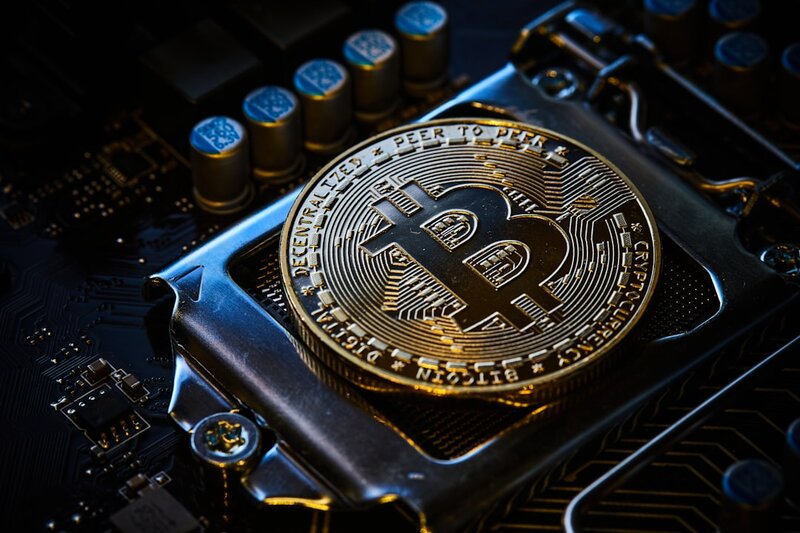
📷 Photo by Michael Förtsch on Unsplash