
The FIFA World Cup 2026 is a week old and crypto is everywhere. Kraken is FIFA’s first Official Crypto Exchange Supporter. Chainlink is feeding match data to prediction markets. Avalanche powers the NFT collectibles. Fan tokens for Argentina and Portugal give holders voting rights on team decisions.
And somewhere in the middle of all this, over two billion dollars in World Cup prediction market volume has been processed on-chain since June 11th.
Two billion. In seven days. On matches like Czechia vs South Africa and Canada vs Qatar.
But here is the thing nobody is saying out loud: not a single one of those prediction markets is provably fair.
TL;DR
- The FIFA World Cup 2026 has driven over $2 billion in crypto prediction market volume in its first week
- Kraken is FIFA’s first crypto exchange sponsor; Chainlink provides oracle data feeds for on-chain markets
- Prediction markets use Chainlink for data accuracy but none use VRF for provably fair outcome selection
- There is a critical gap between “crypto-powered” and “provably fair” that most platforms ignore
- Satoshie’s Chainlink VRF architecture is the standard these platforms should be building toward
Crypto Finally Got Its Mainstream Moment
Let us give credit where it is due. The World Cup crypto integration is genuinely impressive. Six billion fans globally. Sixteen host cities across the US, Canada, and Mexico. And for the first time in history, a crypto exchange has a formal sponsorship tier alongside the likes of Coca-Cola and Adidas.
Kraken’s deal is not some logo slapped on a banner. They are running fan activations across all sixteen host cities. Chainlink is not just providing price feeds for DeFi protocols anymore. They are connecting real-world match outcomes to on-chain settlement, ensuring the data feeding prediction markets is accurate and tamper-proof.
This is exactly what crypto adoption is supposed to look like. Real infrastructure, real users, real use cases.
So what is the problem?
The Problem Is What “On-Chain” Actually Means Here
When prediction markets say they are “on-chain,” they mean the bets settle on a blockchain. The money moves through smart contracts. The outcomes are fed by oracles. All of that is good. It is better than the alternative, which is trusting a centralised bookmaker to honour your bet.
But “on-chain settlement” is not the same as “provably fair.”
In a prediction market, the outcome is determined by an external event. Brazil beats Morocco or they do not. The oracle reports the result. The smart contract settles accordingly. The chain is a settlement layer, not a fairness layer.
Now compare that to a game where the outcome is generated on-chain. A raffle. A coinflip. A game where the randomness itself is verifiable, not just the settlement.
That is the difference between using blockchain as plumbing and using blockchain as proof.
Chainlink Is Already There. The Platforms Are Not.
Here is what makes this particularly frustrating. Chainlink already has the technology to make on-chain gaming provably fair. It is called VRF, Verifiable Random Function, and it does exactly what the name suggests: it generates randomness that anyone can verify was not tampered with.
The World Cup prediction markets use Chainlink for data feeds. They trust Chainlink to report accurate match results. And Chainlink delivers on that trust because the oracle network is decentralised, transparent, and cryptographically verifiable.
But Chainlink VRF, the randomness tool, is sitting right there. Same infrastructure. Same trust guarantees. Same cryptographic proofs. And almost nobody in the World Cup crypto ecosystem is using it for gaming outcomes.
Satoshie uses Chainlink VRF for every single game. Every raffle draw. Every coinflip. The randomness is generated off-chain by the VRF oracle, then verified on-chain by the smart contract before the result is accepted. Nobody, not even the platform, can influence the outcome. That is what provably fair actually means.
Two Billion Dollars Deserves Better Architecture
Two billion dollars in prediction market volume is not a toy number. That is real money from real people making real bets on real outcomes. And the infrastructure handling those bets is genuinely good. On-chain settlement is a massive improvement over traditional bookmakers who can change odds, delay payouts, or simply disappear.
But we are in 2026 now. The bar should be higher than “better than a traditional bookmaker.”
The bar should be: can you verify every single aspect of this game on-chain? Not just the settlement. Not just the data feed. But the fairness of the outcome itself.
For prediction markets tied to real-world events, the outcome is determined by reality. Fair enough. But the moment you introduce any element of randomness, any tiebreaker, any selection mechanism, any game mechanic that is not purely deterministic, you need VRF. You need provable fairness. You need the chain to do more than just move money.
The World Cup Should Be a Wake-Up Call
The World Cup is proving that crypto can operate at mainstream scale. Billions in volume. Millions of fans. Institutional sponsors. Regulatory clarity in the host nations. All the pieces are in place.
But mainstream scale without mainstream standards is just a bigger version of the same problem. Traditional online casinos handle billions too. They just do it behind closed doors, with proprietary RNG that nobody can audit.
Crypto was supposed to fix that. Not replicate it with better branding.
Satoshie exists because we believe every game, from a $5 coinflip to a World Cup prediction, should be verifiable. Not because we say so. Because the cryptography proves it.
The World Cup brought crypto its biggest mainstream moment. Now it needs to earn it.
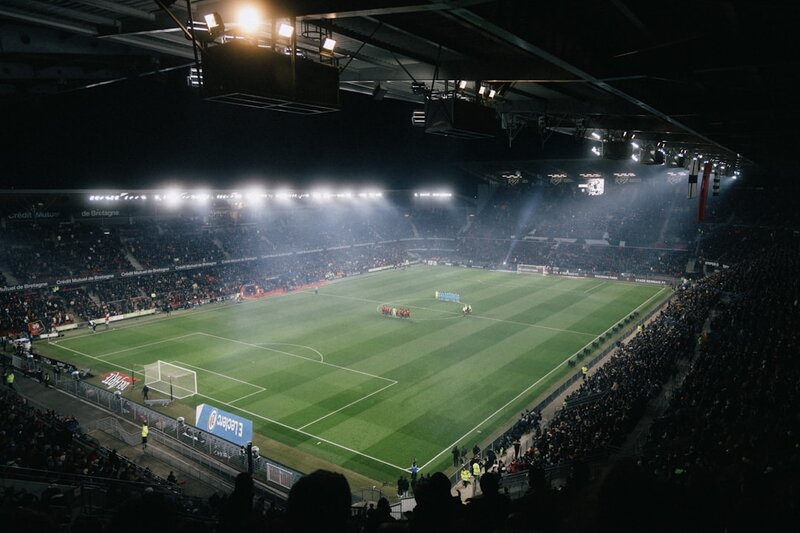
Photo by Howard Bouchevereau on Unsplash