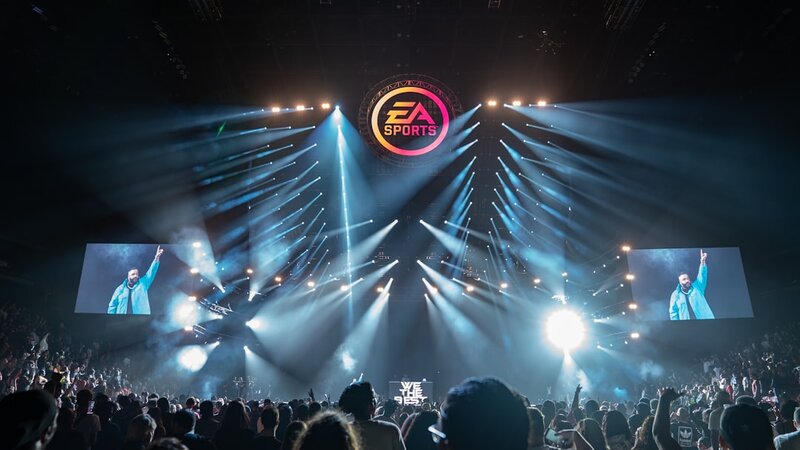

The Esports World Cup 2026 kicked off this week in Paris with a record $75 million prize pool, 25 game titles, and a brand-new framework that finally lets licensed crypto companies sponsor competitive gaming teams. Crypto logos can now appear on jerseys. Blockchain brands can buy visibility in front of millions of viewers. The industry just got its biggest mainstream gaming endorsement yet.
And not a single game in the tournament can prove its outcomes are fair.
TL;DR
- The Esports World Cup 2026 in Paris features a record $75M prize pool and, for the first time, permits licensed crypto sponsors on team jerseys
- France’s regulatory framework allows crypto sponsorship but bans token integrations, NFT collectibles, and on-site blockchain activations
- Despite crypto’s presence as a sponsor, none of the 25 games in the tournament use provably fair mechanics or on-chain verification
- The EWC proves that regulators can figure out how to control crypto branding in gaming, but nobody is asking whether the games themselves are verifiably fair
- Satoshie and Chainlink VRF represent the standard that competitive gaming should adopt: outcomes verified on-chain, not trusted to servers
Crypto Gets a Seat at the Table, but Not a Say in the Rules
The move from Riyadh to Paris was driven by geopolitical uncertainty in the Middle East, but it came with an unexpected upside for crypto. France’s regulatory environment, shaped by MiCA and its own national licensing framework, gave the EWC organisers a clear path to allow blockchain sponsors for the first time. Licensed French crypto entities can now appear on team jerseys and in broadcast overlays.
But the restrictions tell you everything about how the traditional gaming industry views crypto. No on-site activations. No direct token integrations. No NFT collectibles, no blockchain-based voting for MVP awards, no tokenised loyalty programmes. Crypto gets the visibility, but none of the utility.
The message is clear: we will take your money, but we do not trust your technology.
$75 Million in Prizes, Zero Verifiable Outcomes
Let that number sink in. Seventy-five million dollars distributed across 25 competitive titles, watched by tens of millions of viewers globally. VALORANT, Counter-Strike 2, League of Legends, Fortnite, and more. These are the biggest games in the world, backed by some of the most sophisticated technology stacks in entertainment.
And every single one of them runs on server-side logic that nobody outside the developer can verify.
When a VALORANT player lands a headshot, the hit registration happens on Riot’s servers. When a Fortnite circle closes, Epic’s algorithm decides where. When loot drops in any of these games, the randomness is generated server-side, invisible to players and spectators alike. For competitive integrity at this level, with this much money on the line, the gaming industry relies entirely on trust.
Trust that the servers are running the correct code. Trust that no insider can manipulate outcomes. Trust that the random number generators are actually random.
This is exactly the problem that provably fair on-chain gaming was built to solve.
The Irony Nobody Is Talking About
Here is what makes this genuinely absurd. The EWC now has crypto sponsors. Blockchain companies are literally paying to have their logos displayed during matches where outcomes cannot be verified on any blockchain. The technology that could prove these games are fair is sponsoring events that refuse to use it.
It is like a dashcam company sponsoring a car race where cameras are banned.
The crypto sponsors getting jersey space at EWC 2026 are not there because competitive gaming suddenly believes in decentralisation. They are there because France figured out a regulatory framework that makes crypto sponsorship money clean enough to accept. The same regulators who greenlit crypto logos on jerseys have explicitly banned the technology from touching the actual games.
This is not adoption. This is advertising.
What Provably Fair Actually Looks Like
At Satoshie, every game outcome is determined by Chainlink VRF, a verifiable random function that generates randomness on-chain. When a raffle winner is selected or a coinflip lands, the result is not decided by a server that you have to trust. It is decided by cryptographic proof that anyone can verify, on the blockchain, after the fact.
No admin keys. No server-side manipulation. No trust required.
This is not a theoretical improvement. It is a fundamentally different architecture. Traditional gaming asks you to trust the house. Provably fair on-chain gaming removes the house from the equation entirely.
The EWC’s $75 million prize pool is impressive. But when you cannot verify a single outcome in any of the 25 games, that money is being distributed based on trust, not proof. For casual viewing, that might be fine. For an industry that is now taking crypto sponsorship money, it is increasingly difficult to justify.
The Standard Is Already Here
France’s regulators proved something important this week. They proved that crypto can exist in competitive gaming without the sky falling. Licensed entities, clear rules, no chaos. The framework works.
But they only solved half the problem. They figured out how to regulate who sponsors the games. They have not yet asked whether the games themselves meet the transparency standard that blockchain was built to provide.
That question is coming. As crypto sponsorship money flows into competitive gaming, players and regulators will eventually ask why the technology paying for visibility is not being used to verify the outcomes it is sponsoring. When that day comes, the platforms that were already provably fair will not need to retrofit anything.
They will just point to the chain.
📷 Photo by Josh Berendes on Unsplash